Name days on December 24
Saints and feasts of December 24
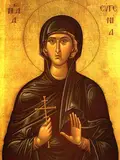
Eugenia of Rome
Martyr, Ευγενία
The holy virgin martyr Eugenia was the daughter of a distinguished Roman family in the third century. Coming to faith in Christ, according to tradition she fled a life of privilege, entered monastic life disguised as a man, and became known for holiness and healing; after many trials, in which her identity and her innocence were revealed, she returned to Rome and was put to death for the faith in the persecutions of that age.
Philip the Martyr
Martyr, Φίλιππος
The holy martyr Philip was the father of St. Eugenia and governor of Egypt under the Roman emperors. Brought to faith through his daughter, tradition relates that he was made Bishop of Alexandria and was slain for Christ.
Ahmed the Calfa
Martyr, Αχμέτ ο Κάλφας
The new martyr Ahmed was a Turkish official in Constantinople in the seventeenth century. Tradition relates that, attending the Divine Liturgy, he saw a light descend upon the Christians, and was baptised in secret. When he openly confessed Christ before his fellow officials he was beheaded in 1682.
Basilla the Martyr
Holy Woman, Βασίλα
The holy virgin martyr Basilla was a noble maiden of Rome who was brought to faith by St. Eugenia. Refusing marriage for the sake of Christ, she was slain by the sword.
Protas and Hyacinth
Martyr, Πρωτάς και Υάκινθος
The holy martyrs Protas and Hyacinth were servants of St. Eugenia who followed her into the monastic life and shared her confession of Christ. They were beheaded at Rome.
Nicholas the Monk
Venerable, Νικόλαος ο από στρατιωτών
Venerable Nicholas was a soldier of the Byzantine army in the ninth century. Tradition relates that, having resisted temptation on the eve of a battle, he was shown in a vision that he alone of his company would be spared, and in thanksgiving he left the army and became a monk, living in repentance until his repose.
Antiochus the Monk
Venerable, Αντίοχος
Venerable Antiochus was a monk of the Lavra of St. Sabas in the seventh century. After the Persian invasion of Palestine he composed the Pandects, a compendium of Scripture and the Fathers for the use of monks, and reposed in peace.

The calendar, on your phone each morning
Today’s saints, whether it is a fast day, and the people in your contacts who have a name day. Free, with no ads.