Name days on January 30
Hippolytos, Hippolyte, Basil, Gregory, John, Vasilis, Grigoris, Giannis, Chryse, Chrysi, Chrysa, Chrysoula
Saints and feasts of January 30

Hippolytos
Martyr, Ιππόλυτος
St. Hippolytos was a martyr of the Church of Rome who gave his life for Christ during the persecutions of the third century. The synaxaria preserve little of his story beyond his faithful confession and his death for the Lord, in company with other martyrs of that city.
Name days: Hippolytos, Hippolyte
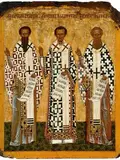
Three Holy Hierarchs
Great Feast, Τρεις Ιεράρχαι
The feast of the Three Holy Hierarchs honors together Sts. Basil the Great, Gregory the Theologian, and John Chrysostom, the great fathers and ecumenical teachers of the Church. According to tradition, the common feast was established in the eleventh century after disputes arose in Constantinople over which of the three was greatest; the hierarchs made known in a vision that they are one before God, and a shared commemoration was appointed.
Chryse the Martyr
Holy Woman, Χρυσή
St. Chryse was a Christian maiden of Rome in the third century who, tradition relates, had been exiled for her faith and lived at Ostia, where she encouraged the confessors imprisoned there. She was tortured and drowned in the sea with a stone about her neck.
Kensourinos and Sabinos
Martyr, Κενσουρίνος και Σαβαΐνος
Sts. Kensourinos, a Roman magistrate, and Sabinos were among those who confessed Christ at Ostia in the third century together with St. Hippolytos and St. Chryse. Tradition relates that Kensourinos believed after seeing a dead man raised through the prayers of a Christian priest, and was beheaded.
Theophilos the New
Martyr, Θεόφιλος ο Νέος
St. Theophilos the New was a commander of the Byzantine forces in Cyprus in the eighth century. Captured by the Arabs, he was held for years in prison and, refusing to deny Christ, was beheaded around 792.
Theodore Hatzis of Mytilene
Martyr, Θεόδωρος ο Χατζής
St. Theodore was a Christian of Mytilene who had in a moment of weakness embraced Islam. Repenting, he returned openly to Christ, confessed his faith before the judge, and was hanged in Mytilene in 1784.
Finding of the Icon of the Annunciation in Tinos
Saint, Ευαγγελίστρια Τήνου
On January 30, 1823, after visions granted to the nun St. Pelagia of Tinos, the wonderworking icon of the Annunciation of the Theotokos was found buried in a field on the island of Tinos. The great church of the Evangelistria was built over the spot, and the island became the foremost place of pilgrimage in Greece.
Pelagia of Diveyevo
Holy Woman, Πελαγία του Ντιβέεβο
St. Pelagia was a married woman of Arzamas who, with the blessing of St. Seraphim of Sarov, took up the life of a fool-for-Christ and lived at the Diveyevo convent, enduring beatings and mockery with patience. She was granted the gifts of clairvoyance and healing.

The calendar, on your phone each morning
Today’s saints, whether it is a fast day, and the people in your contacts who have a name day. Free, with no ads.