Name days on November 27
Saints and feasts of November 27
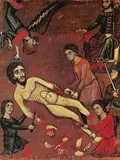
James the Persian
Martyr, Ιάκωβος ο Πέρσης
The great martyr James the Persian was a Christian noble at the Persian court in the fifth century who, to please the king, denied Christ. Rebuked by the grief of his mother and his wife, he came to himself, repented, and confessed his faith before the king, for which he was condemned to a slow death by dismemberment; he endured it with prayer, and for this he is called the Cut-to-Pieces.
Pinouphrios the Venerable
Venerable, Πινούφριος
Saint Pinouphrios was abbot of a large monastery near Panephysis in Egypt in the fourth century. Fleeing the honour shown him, he twice left secretly, once to serve as an unknown novice in a monastery at Tabenna and once to Palestine, until he was recognized and brought back.
Nathanael the Venerable
Venerable, Ναθαναήλ ο Όσιος
Venerable Nathanael was a monk of Nitria in Egypt in the fourth century. Tradition relates that after being tempted to leave his cell he resolved never to step across its threshold, and kept this rule for nearly forty years.
Gregory of Sinai
Venerable, Γρηγόριος ο Σιναΐτης
Saint Gregory was born in Asia Minor in the thirteenth century and became a monk on Mount Sinai, later settling on Mount Athos, where he taught the practice of inner prayer to many disciples. Because of Turkish raids he withdrew to Paroria in Bulgaria, where he founded a monastery.
Theodosius of Trnovo
Venerable, Θεοδόσιος του Τυρνόβου
Saint Theodosius was a Bulgarian monk who became a disciple of Saint Gregory of Sinai at Paroria and later founded the monastery of Kilifarevo near Trnovo, which became a centre of hesychast spirituality and learning. He defended Orthodoxy against heresies at councils in Trnovo.
Damaskenos the Studite
Hierarch, Δαμασκηνός ο Στουδίτης
Saint Damaskenos was born in Thessaloniki in the sixteenth century and became a monk of the Studion. He was later Bishop of Liti and Rentini and Metropolitan of Naupaktos and Arta, and is remembered for his collection of homilies in the vernacular, the Thesauros, which was read throughout the Greek world under Ottoman rule.
James of Rostov
Hierarch, Ιάκωβος Ροστοβίας
Saint James was Bishop of Rostov in the fourteenth century. Tradition relates that when he spared a woman condemned to death, the people drove him from the city; he spread his mantle on the lake and floated across it, and founded a monastery on the far shore.

The calendar, on your phone each morning
Today’s saints, whether it is a fast day, and the people in your contacts who have a name day. Free, with no ads.